Showing posts with label non-AFOLs. Show all posts

Friday, 3 April 2015

It was all basic bricks in my day: part three

Well, that took longer than expected. You've waited long enough, so I'll dive straight into the results with a minimum of introduction. On the assumption that any part that appears in sets from multiple themes can't be particularly specialised I've defined a specialised part here as one that has appeared in less than 25% of Bricklink's categories. At the time I started collecting data, this was 28 categories, so a specialised part is one that has appeared in less than 28 categories.

Here's the graph of the average proportion of a set's part that are specialised each year/decade:


Or, if you prefer, a graph of the proportion of sets each year that contain  more than 50% specialised parts:


Conclusion: Sets these days are not full of overly specialised parts - they're pretty much the least specialised they've ever been!

Update: I wouldn't pay too much attention to the startlingly high results for the 50's and 60's since, for reasons explained in the updates and comments below, they are known to be erroneously inflated to some degree. I'm in the process of trying to fix this.

The bad years of the late 90's and early 2000's, when specialised parts supposedly proliferated wildly, are clearly visible on the second graph, but they're perhaps not as bad as you might have expected. On the averages graph, they don't seem that bad at all. I guess we tend to focus on the worst examples from those years, without acknowledging that the majority of sets weren't that bad.

What you can clearly see on both graphs, beginning around 2006, is the effect of stricter controls on set designers' use of specialised parts. In David Robertson's book, Brick by Brick, he says:
"As a result [of the new rules], on average, at least 70 percent of every LEGO set, whether it's a LEGO City box or a new play theme such as Ninjago, is now made up of standard, universal bricks."
Lo and behold, by 2007 the averages graph is below the 30% mark and has stubbornly stayed there ever since.*

So that's what I found. Let me know what you think in the comments, or carry on reading to find out the details of the data collection, including some known flaws.

In my next post, which will follow shortly, I'll be breaking the data down by themes and looking at things like whether licensed sets are more specialised than non-licensed.

***

Update: Another flaw, which I just noticed as a result of the very first comment, is that older versions of basic bricks end up counting as specialised because they were phased out before having the chance to appear in lots of themes. I think this accounts for the unusually high proportions of specialised bricks and sets in the 50's and 60's. Luckily, since Bricklink appears to have labelled these older versions in a consistent way ('[item #]old'), this should be reasonably simple to fix.
To some extent this error actually cancels out some of the error from double counting counterparts mentioned below, since in sets where less common older bricks appear as counterparts, they will be cancelled out by the more common versions. 
In my last post, you may remember that I found the proportion of basic bricks and plates has fallen over time (in a limited sample of sets). That may seem completely at odds with the results in this post, and may partially be explained by older versions of basic bricks counting as specialised. But I think it's mostly because the definition of specialised in this post is closer to the AFOL's definition ('can't be used for anything else') rather than the traditionalist's definition ('isn't a cuboid brick or rectangular plate').

All data was collected from Bricklink using a web scraping program I wrote in Python. I'm happy to share the code, but be warned that it isn't pretty. A lot of the flaws below could probably be fixed with smarter web scraping, but I'm not willing to spend huge amounts of time figuring it out in the near future. If anyone reading is good at Python and/or web-scraping and would be willing to help out, let me know, and I'll make the code public so we can all work together on improving it.

The data is not weighted by the number of each part in the set. So if a set contains one specialised part and fifty 2x4 bricks, it still counts as 50% specialised. To be honest, I did this because it made the data scraping easier. I'm happy to discuss how this will have affected the results in the comments, but if you want it done differently you'll have to help me rewrite the code!

I removed all sets that Bricklink puts in the Duplo category, as well as any set with Duplo in its name (this catches educational Duplo sets and the like). While Duplo bricks are compatible with normal Lego bricks, they never show up in any Lego sets, so Duplo sets always come out as 100% specialised and skew the data. Contrast with Technic, which shows up in normal Lego sets all the time.

I also excluded any set with less than 10 types of part, to get rid of the majority of little promo sets and advent calendar builds etc.

The parts counted are anything in a set's Bricklink inventory that Bricklink defines as a part. Which is to say any part whose catalogue entry has a URL including P=[part number]. This excludes minifigs (deliberately) but unfortunately doesn't exclude stickers or counterparts. Again this is something that I found too complicated to fix, and since stickers and counterparts rarely make up a huge proportion of a set's parts, it hopefully doesn't affect the data too much.

One final flaw I only spotted after digging into the data for my next post is that if a part appears twice in the same set in multiple colours then it will count once for every colour. So if a set has 20 different types of part and 3 of them are the same specialised part in 3 different colours then, assuming no other specialised parts or colour variations, the proportion will be 3/22, rather than the 1/20 I'd prefer. I don't think it will have made any difference to the overall trends however.

I think that's all that needs mentioning - if you want more details, just ask.


* Amazing, right? I randomly chose 25% of categories as the threshold and it just turned out that this squared very nicely with recent averages being below 30% specialised. I definitely didn't try out a few different thresholds on a sample of recent sets until I found one that placed the average just below 30%. No siree! 

Wednesday, 20 August 2014

It was all basic bricks in my day: part two

Note: In the process of writing this post, I realised that to get it done properly on decent sized datasets I was going to have to write some data scraping scripts. Since I've never done that before and it might take a while to figure it out, I decided to post what I'd already done anyway. Consider it a proof of concept for now.

In part one of this series, I took a look at the claims that all sets come with instructions these days, and that there are no basic brick boxes and buckets any more. Since these were extremely easy to disprove, I also looked at the historical trends to see if there are more sets with instructions and less basic brick boxes than there used to be.

In this part, I'll look at the claim that sets these days are filled with specialised pieces that can only be used for one thing. New Elementary has already shown that anyone claiming 'it was all basic bricks in my day' is entirely wrong, but is there any truth to the idea that today's sets have more specialised pieces than those of yesteryear?

For most Lego builders, the phrase 'specialised piece that can only be used for one thing' is likely to be taken as a challenge to find a way to use that piece for something else, hopefully resulting in massed cries of "NPU!". So the definition of a specialised piece is very subjective. If we want to objectively look at whether specialised pieces are more commonplace these days, we need some numerical definition of a specialised piece.

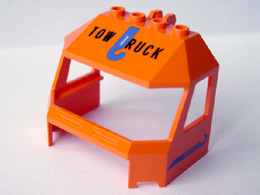
The best I can think of is how many sets a piece appears in. According to Bricklink, the iconic 2x4 brick, surely the least specialised of all pieces, has appeared in 1923 sets, whereas the highly specialised printed tow truck windscreen piece below has only ever appeared in one set. It's not a perfect measure by any means, but it might do for our purposes.

Nice colours though.

The question now is what number of sets should a piece have to appear in before it's proven itself non-specialised? More than 10? Let's run the numbers. Since I mentioned tow trucks at the end of the last post, we'll look at 16 tow trucks TLG has produced over the years, and count the proportion of pieces that have appeared in fewer than 10 other sets*. Since these sets are mostly quite small (average 73 pieces) and to ensure a spread of different model types, I'll also look at 19 mid-size spaceships (average 200 pieces) and 12 train stations (average 360 pieces) as well:


What does this tell us? Well, firstly, pieces that appear in fewer than 10 other sets are really quite rare - almost always less than 5% of a set's parts. There are some higher proportions among the tow trucks and this is partly because they tend to be small sets, where just a few specialised parts will constitute a sizeable percentage of the total. Those who know a little bit about the history of Lego probably won't be surprised that the truck with 28% specialised parts was from the early 2000's, a time when the number of parts and colours spiralled out of control, with many 'juniorised' sets, containing large specialised pieces. You'll notice that this is the set that contains the unique windscreen pictured above.

Yuck. They deserved to almost go bankrupt just for inflicting
this abomination upon the world.

Those with their thinking caps on may have noticed a possible flaw in my definition. Take a specialised part that can only be used in one way, say, a tow truck's winch. Then we say that a non-specialised piece will have been used in more than 10 sets. But there have been 16 tow trucks! So if every tow truck used the same winch piece, it would have been used in 16 sets, despite only being used in one very specific way. So clearly we need a higher threshold. Probably much higher. There have been 16 tow trucks, but scores of spaceships, and we don't want a specialised spaceship piece to slip through the net if it's never been used for anything else.

So let's up the ante and define a specialised part as one that's appeared in fewer than 100 other sets:


Assuming this data is representative of all sets, and that our definition of specialised pieces is good enough, we can say the following claims are nonsense:

  • "Sets these days are all/mostly specialist parts" - in fact the vast majority of sets are (and always have been) less than 30% specialist parts, and the only set that can be described as mostly specialist parts is that abomination of a tow truck from 2003.
  • "Ok, but they definitely include more specialist parts than they used to" - nope, and possibly the opposite, though I'd want more data to be sure of that.

Of course, if you quit Lego in disgust in the early 2000's and haven't checked out any sets since you may be partially justified in holding these opinions. It's interesting that there's a definite rise in specialised parts visible for the train stations in the early 2000's, but whether that's indicative of the known trend or just a coincidence is impossible to say given the small sample size.

Is this data representative of all sets? I don't know. The only way to tell is to repeat it for other similar sets of sets. I chose tow trucks and stations because they were some of the earliest models available and they keep being regularly made throughout the decades (spaceships didn't appear until a bit later, but have been regularly made since). I'm doing the data collection manually (indeed, literally on the back of an envelope), so I want to settle on a definition of specialised parts that I'm happy with before making efforts to analyse more sets.

Let's try a different approach. Instead of trying to define a specialised part, let's make a really strict definition of a non-specialised part - the sort of definition the oldest, grumpiest, most die-hard "Lego is rubbish these days" critic might use. Non-specialised pieces are those from these Bricklink categories:
No stupid 'modified' bricks or plates, no pretty round bricks, none of your newfangled slopes for making nice roofs, and no tiles for fussily hiding the studs. If you can't make your model out of rectangular bricks and plates, this guy isn't interested. In fact he's positively disappointed in you, and he only grudgingly allowed plates to give you a chance. Let's see what this definition gives us:


Well, it's hard to argue with that. The proportion of a set that is just bricks and plates has indeed decreased over time. The lowest point on the graph is our old friend the orange tow truck, narrowly avoiding a 0% score with the inclusion of a solitary blue 2x3 brick. The train stations are consistently comprised of a higher percentage of bricks and plates, almost certainly because they're models of buildings, where basic bricks are clearly more likely to be found.

If we want to be slightly more generous and include slopes and tiles, the graph looks like this:


Mostly unchanged then, though the early 2000's dip becomes more apparent for the train stations.

Conclusions

Here are my conclusions based on what we have, and assuming the findings are representative of all sets:
  • The proportion of a set that is highly specialised pieces, i.e. pieces that appear in fewer than 10 other sets is almost always less than 5%, and hasn't changed significantly over time.
  • The proportion of a set that is specialised pieces, i.e. pieces that appear in fewer than 100 other sets is almost always less than 30%, and hasn't changed significantly over time.
  • The proportion of a set that is just basic bricks and plates has decreased significantly over time.
  • The early 2000's sucked.
Which method is better? The second method is simpler and gives more decisive results. It shows quite clearly that while it wasn't all basic bricks in the old days, sets did tend to have more basic bricks. On the other hand, from an AFOL's point of view, i.e. someone who isn't opposed to specialised pieces per se, as long as they aren't completely unusable for anything else, the first method is more useful. The trick is to choose the correct number of other sets a piece has to appear in to count as non-specialised. One thing I didn't do, because it would have been too time-consuming to do manually, was to exclude uses of a part in models from the same theme. For example, when looking at spaceships, if a piece has appeared in 110 other sets I would have counted it as non-specialised. But if 50 of those other sets are in the Space theme, it was probably being used for the same purpose in those other sets, meaning that it should only count as appearing in 60 other sets and therefore should count as specialised.

That's the sort of thing I aim to do in future with some clever data scraping, but I have to learn how to do any data scraping at all first, so in the mean time please comment with any feedback or criticism or impassioned defences of orange tow trucks.

Part three of this series will arrive shortly, with less data and more opinions!


    * To simplify the process, I count all minifigs and their constituent parts as non-specialised, regardless of how many sets they've appeared in, because the issue of minifig variety is a slightly different and more complex one than the issue we're considering here. Basically, I counted anything Bricklink defines as a regular part in a set inventory, except sticker sheets.

    Saturday, 9 August 2014

    It was all basic bricks in my day: part one

    If there's one thing you're guaranteed to hear from the general public at an exhibit, it's some variant of "When I was a kid, it was all just basic bricks". And when it's just a well intentioned comment on the detail and complexity of your models, it's not a problem.

    If there are three things you're guaranteed to see in the comments section of any mainstream news or comment article about Lego, it's these:
    • "When I was a kid, it was all just basic bricks" and its related cousin:
    • "All the sets come with instructions these days, and you can't make anything else with them"
    • "Lego is too expensive these days"
    Is this a problem? That depends on whether or not these claims are true. The third was comprehensively disproved in a fantastic blog post by Andrew Sielen, along with the commonly held belief (even among AFOLs) that licensed sets are more expensive.

    This time, I'll take a look at the claims that more sets come with instructions than in the past and/or you can't get basic brick boxes/buckets these days. Next time I'll try to see if today's pieces are more specialised and less useful than they used to be. To tide you over until that post appears, try reading New Elementary's excellent post on the matter. And in a third and final post in this series I'll summarise the findings and give my opinions on whether they're a problem or not.

    Do all sets come with instructions? When people say this, they usually refer to the boxes or buckets of basic Lego bricks they had as a kid. These still exist! Multiple boxes/buckets of bricks are available right now, under the theme Bricks and More. However, most of them do seem to come with some instructions for suggested models. Let's be ultra strict - are there any currently available Lego sets with no instructions whatsoever?

    It even comes with a brick separator in case you don't already have
    at least 300 of them.

    Yes! 10664 Creative Tower has no instructions, and is mostly 'basic' bricks. It would surely satisfy even the most diehard instruction and 'specialised' brick hater. [EDIT: And, as pointed out in the comments, every Lego store has an entire Pick a Brick wall dedicated to selling just bricks, which generally seems to be a third to a half 'basic' bricks.]

    Ok, that's one example, but surely there were more of these instructionless sets back in the good old days? One simple way to see if that's true would be to find the proportion of sets released each year with instructions, and see how that has changed over time. This is relatively easy - it's possible to see a summary of the number of sets released each year at Bricklink, and similarly to see the number of instructions released each year. So we simply divide one by the other to get our proportions.


    Conclusion: If you were a kid in before the in or before the 80's, you may be on to something when you say there are fewer sets without instructions, UNLESS you were a kid in the 70's, when it was about the same. But these numbers don't look quite right. Only three quarters of sets had instructions in 2013? In fact, the raw numbers state 154 sets without instructions, which just doesn't seem right. And indeed it isn't, because Bricklink counts a lot of things as separate sets that really aren't. For example, 75 of those 154 sets are the individual builds from the advent calendars, for which there aren't separate instructions listed. So we can't quite rely on these numbers.

    A set, according to Bricklink.

    Is there another source of set numbers? Yes. Brickset has a brilliant query builder that allows you to run custom queries of its database. I did a simple query for sets in the 'normal' category, which excludes things like keychains and weird promotional items, then used these numbers with the instruction numbers from Bricklink*. The percentages from this are more in line with what I'd expect:


    Ok, apart from the 130% of sets in 1969 that came with instructions, the percentages are more in line with what I'd expect! And I think that's partly because the records for the 60's and early 70's aren't entirely reliable. [EDIT: I wasn't clear enough here that this is a problem caused by using numbers from different databases. Since Brickset and Bricklink don't always agree, particularly in the early years, the occasional weird result is not unexpected if you divide one set of numbers by the other]. If we ignore the 60's, the conclusions are more or less the same as before - the 70's were relatively instruction heavy, and since the 80's the proportion of sets with instructions has been increasing.

    One more test. Let's look at the beloved basic brick boxes/buckets directly this time, and not worry if they happen to come with instructions for a few example models. From Brickset's themes, the ones that appear to be mainly comprised of these brick boxes/buckets, and that aren't Dacta or Educational sets, are Basic, Bricks and More, Bulk Bricks, Creator (pre-2007), FreestyleMake and Create, and Universal Building Set. So I did a query for these that excluded sets with fewer than 100 pieces, to get rid of odd promotional sets and polybags. Because Creator became mostly instruction sets after 2006 (albeit usually with 3 different models) I had to do a query for it separately, excluding sets from 2007 onwards, and add those numbers.

    This seems to show that the number of basic brick boxes/buckets released has been increasing over time, with a slight dip down these past few years. But many more sets are released these days, so the more relevant quantity is the proportion of sets each year that are basic brick boxes/buckets:

    Ignoring the 60's, we see that the proportion of normal sets each year that are basic brick boxes/buckets fluctuates between 0 and 15%, but on average tends to be about 5%, with a slight downwards trend recently.

    So, what do we conclude? In this case I think we may be tempted to concede that Joe Public has a point - there seem to be more sets with instructions these days. I must admit I was surprised that most of the basic brick/boxes available today come with instructions, even if they're just a few example models. I don't think this is really a problem - you can always throw away the instructions after all! I've read that the reason that Lego stopped including back of the box pictures of alternate models on all sets (they were always there when I was a kid) was because they got complaints from parents that their children got upset because they couldn't build these models. So maybe the instructions are more common these days because people actually wanted them.

    When we look at the average proportion of sets each decade that are basic brick/boxes, it's basically been hovering around 5% ever since Lego started including instructions with models. It looks to have been on the slide over the past 20 years, though this is partly due to the increase in total numbers of sets released. For example, the average number of normal sets released per year in the 70's (when the proportion of buckets was highest) was about 62, whereas in the 2010s it's been 387. If we take the 70's proportion of 6.4% and apply it to 387, we get about 25. To those complaining about the lack of such sets, ask yourself if there's a market for an average of 25 basic brick buckets/boxes every year? Has there ever been?

    Final conclusions

    First, let me say that if you disagree with any of the methods or assumptions I've used, then please leave a comment, especially if you can think of a better way. I want this to be as good as possible, and won't take it personally. Now, on to the conclusions:

    If you were a kid in the 50's: Feel free to say there were fewer sets with instructions in your day - essentially there weren't any! [EDIT: See the comments for a discussion of whether there were actually instructions then or not. It seems at least that there weren't the modern, detailed instructions that we're familiar with today.]

    If you were a kid in the 60's: Dig out your old sets and memories and help update the records, because the stats don't have a clear message to tell. We can at least say that there weren't any sets with instructions before 1964. [EDIT: Not quite, see above]

    If you were a kid in the 70's: There were fewer sets with instructions in your day (72% of normal sets vs. 97% in the 2010s) but you actually grew up in a time of relatively many instructions compared to the following decades. There were slightly more basic brick boxes/buckets in your day (6.4% of all normal sets vs. 2.3% in the 2010s).

    If you were a kid in the 80's: There really were fewer instructions in your day (55% of normal sets vs 97% in the 2010s) and you grew up in the least 'instructioned' time since instructions began. There were slightly more basic brick boxes/buckets in your day (4.3% of all normal sets vs. 2.3% in the 2010s).

    If you were a kid in the 90's: There were fewer instructions in your day (64% of normal sets vs 97% in the 2010s). There were slightly more basic brick boxes/buckets in your day (6.2% of all normal sets vs. 2.3% in the 2010s).

    If you were a kid in the 2000's: There were fewer instructions in your day (79% of normal sets vs 97% in the 2010s). There were slightly more basic brick boxes/buckets in your day (4.1% of all normal sets vs. 2.3% in the 2010s).

    If you are a kid in the 2010's: Then why on earth are you reading this?? Go play with your Lego, and be glad you aren't a boring old fart who thinks this tow truck is better than this one.


    I mean, really? Images from Brickset.

    * Why carry on using the Bricklink instruction numbers? Simply because it's the most complete record.  Brickset only has the instructions that are provided by Lego Customer Services, which are woefully incomplete before the mid-nineties. Peeron is the other well-known source of instructions, but seemingly hasn't been kept properly up to date for about 10 years now, and hasn't had any new scans since 2010.


    [EDIT: Purple Dave asked in the comments for a graph of absolute number of sets without instructions, so here it is:

    The overall trend is similar to that of the number of basic brick boxes/buckets, which is encouraging.]